
the president has gone insane
rory waugh
I watch him do it: retrieve his chainsaw, saw off the head, and then somehow tie it to the roof of his minivan. His navy blue windbreaker and black rubber boots are all that stand between him and the juices. Once he gets that chainsaw started, shrapnels of flesh fly from the tiny ridges into his face, but he doesn't care. I try to retrieve one of the pieces from his hood, as I am lazy and prefer my food cut up anyway, but he shoos me away. The others cower, some flee the scene, but not me. I am persistent. A mother has never deterred me from stealing a kid’s sandwich, just like this man will not deter me from my fair share of whale meat.
Before he got there and ruined it all, the beach was an extravaganza. Gulls and sandpipers, crabs and minnows, lobsters and horseshoe crabs all feasting in harmony. I had heard stories of whale fall from the hagfish in Alaska, but I never thought I’d get to experience it for myself. I had plans, big plans—I would stay here for a couple months, getting fat off of blubber, and then when I was good and ready I would hibernate like the bats in Washington taught me. But this man. This barely five-foot-eight, minivan-owning man decided to come here and ruin the fun. I’m not even sure how he found the place. Humans never come to this damn beach, and that’s why I liked it. Now the harmony is gone, balance thrown, sand stained red like the angry morning sky above us. I guess you can’t have someone come in and chop off the head of a beached whale and expect the mood not to dampen afterwards. Party foul.
I decide to follow him. I tell the crabs not to miss me too much and bury my small collection of shiny objects in the dunes so no one else can find them—that’s about all I had going for me here.
I waddle in the wake of the head as he drags it through the sand—the whale’s floppy tongue collects jagged bits of shell as it goes. If anyone caught him in this state, he would look like a full blown murderer; hood just barely covering his face, jeans covered in whale guts, no remorse in his eyes.
He reminds me of a woman I once tortured on Long Island a few years back. She had a hot dog in one hand and the leash to a dog in the other. That poor dog looked like she hadn’t eaten in days and the woman kept yelling at her, so I did the humane thing and knocked the hot dog out of her hands and into the dog’s mouth. I hung around in the area for a bit longer just so I could shit in her general direction when I got the chance.
The whale guy finally gets the head up the boardwalk and starts tying it to the car roof. His use of bungee cords makes it clear this is what he had set out to do when he woke up this morning. That, or he falls upon these situations often enough to prepare for them. When he finally gets the head secured, I watch for a moment. Blood, or perhaps other miscellaneous fluids, spill down the rear window, showering the little family bumper stickers in red.
Once the van gets moving, I don’t turn back to see the place I’m leaving behind. I never do.
The first time a passing driver rubbernecks, they almost swerve off the two-lane highway and into the deep Massachusetts forest. But luckily, they’re able to process the image of a whale head tied to the roof of a minivan fast enough to not kill themselves. This happens at least five times in the first hour. It makes me wonder about the willpower of those who don’t swerve. If a whale-head-minivan doesn’t get you, what does? Where do you draw the line?
A few of the cars get creative with it as we pass through Rhode Island. One lady, barely tall enough to see past her own steering wheel, flashes her brights in a rather unrhythmic manner. This doesn’t faze the man at all; he drives on no matter what. Even when a guy sticks his whole upper body out the back window of a car and tries to slap the head, he keeps the van steady. He stays at the speed the wind resistance of the whale allows him to go.
Somewhere along the way, we pass the state border for Connecticut. Maybe we’ve passed other borders as well, but I’m too tired to keep track of them. The only billboards I ever notice are ads for local attorneys. I don’t like the way they stare back at me.
On top of my ever-growing fatigue, the guy is really pushing the limits of his bungee-cord-minivan setup. He’s gained a sizable lead on me. In order to keep up with him, I decide I must land on top of the car.
I keep my eyes straight ahead, well as straight ahead as possible, and flap my wings like my life depends on it. I feel as if I’m going speeds no seagull has ever gone before—even if it’s just because they’ve never tried—but this is easier than continuing to stare down the lady from Goff Law Group. If I ever see her on the streets, she’s getting the Long Island dog owner treatment for sure.
The car is almost in my grasp when, to my surprise, he starts slowing down. I’m getting ahead of the car. I can’t slow down fast enough. I am directly above the windshield. I try to act natural. Like I’m just casually breaking the fastest seagull world record, and I just happen to be flying over this specific minivan. Nothing suspicious going on at all. Despite all my instincts, I look down. Luck is on my side and the man is now wearing a baseball cap. There’s no way he sees me. I catch my breath and slow down, landing gracefully on the whale head. Only then, I realize he’s pulling off the highway.
We drive about a mile or so off the highway to what I think is a Walmart, but I’m too busy trying not to draw attention to myself to really notice. I move from the front of the whale head to where it's been severed from the rest of the body. As I do this, the guy parks the minivan in the farthest possible corner of the lot.
Not much time passes before I hear a loud flapping noise from the front of the van. I peek from behind the whale to see two enormous black wings emerging as if the head has just sprouted them. The creature is a vulture. I can tell by the flash of skin I catch between movements. Its head is bald, wrinkly, and black like the rest of its body. It looks like death walking.
I creep my way around the side of the whale, careful not to make too much noise, but failing all the same. The vulture’s beak is deep in the flesh of the head, covered in its blood. I figure the fluids have all dripped out on the drive here, but the meat is almost made fresh again by the bird’s ravenousness. He eyes me, never stopping his feasting, but never getting in my way. I stand frozen, staring at him. He loses interest in me and fixes his eyes back on the whale. This goes on for a moment longer before he takes a break.
After standing in silence for a bit, he asks me, “You not hungry?”
I stare at the gaping hole in what I’d call the whale’s forehead. “I’m full, thanks.”
“We don’t usually get your kind up here,” he says, picking bits of something out of his feathers.
I think for a moment. I don’t believe I’m in any present danger with him. Despite his larger stature, he seems docile. “You get many whales up here?”
He almost chuckles.
I can’t stop staring at the gaping hole in the head. I wonder if the man will notice. I wonder if he’ll be angry. I wonder if it even matters to him. “You were quite hungry,” I say, not thinking much of it.
“Always,” he says. I look back over at the vulture and he has stopped moving. He stares at the whale head, his posture erect. His eyes are black chasms against skin that looks almost gray now that the sun is out. “You hitching a ride?” He asks, gesturing to the car.
“Something like that,” I respond.
He squints at me. “Something like that?”
I tell him that I’m following the man, and therefore the whale head, to wherever they’re headed. He only nods and licks at the blood left on his beak. Then he asks why I’m following the man. I have to think about it for a moment.
“I guess I’m angry,” I finally say. “I’m angry that he took it and I don’t want him to think he can get away with it.”
He grunts.
“Would you not be angry, too?” I ask him, sensing that he disagrees.
“But aren’t you also a little curious?” He sighs and looks over into the parking lot at the only car with people by it. A man and woman stroll toward the store, hand in hand. They pass a flock of grackles that scatter when they approach. “It’s funny how little they notice us.”
“What’re you trying to say?”
“Nothing much.” He shakes his feathers. “Just make sure he notices you.” Then before I can ask him to clarify, he asks me, “What’s it like out there?”
I assume he means the ocean, but really I have nothing to say about it that couldn’t be said about a desert, or a tree, or a Walmart parking lot. It’s a place and it changes. The beaches I’ve been to are no longer the same beaches I knew. And besides, these days, beaches have become less about the beach itself and more about what junk I can find.
“More of the same,” I tell him.
He chuckles again. “I knew it,” he says, shaking his head. He stretches his wings out before taking off once again. They almost reach longer than the width of the car. I watch as he flies away until the trees engulf him and he’s no longer distinguishable against the terrain.
The man is only gone for a little while longer before coming back with a can of Coke, a bag of potato chips, a tarp, and a smug look on his face that should only be reserved for lawyers on billboards. I peer at him from behind the whale head, waiting for him to make his move with this tarp. He starts to walk to my side of the head and I panic. There’s nowhere to hide—nowhere but the obvious. So with no other choice, I wiggle my way inside of the head.
It’s not as bad as you might think the inside of a dead whale head would be, but it’s still not great. It kind of reminds me of the great pacific garbage patch. I saw it once. It was exactly what one would imagine: a giant patch of garbage. But the smell wasn’t as awful as the pelican I met in Miami made it seem. I should have known—that guy was a true born con artist. Bordering on the eccentric, he made the garbage patch out to be the eighth wonder of the world. So I went. And it was nothing you wouldn’t find in the back alleys of the world. The parts they try to hide under dirt and behind buildings. Except here it’s right in the middle of the ocean—right where they haven’t found a way to put a building yet. But I try not to think about that for too long, so back to the whale head.
I can see just a sliver of the man’s face through the hole in the blubber, and I think he almost sees me too. I look him right in the eyes because there’s not much else I can do from in here, but I’m wrong. He doesn’t see me. I hear the ruffle of the tarp and what little light I have goes out.
I wait for him to start the car again before I try to get out of the head. It’s starting to smell like rot and the constant sounds of the remaining innards sloshing around are getting to me. I almost start flapping my wings from joy when I feel the car engine start, but getting out of the head proves much harder than getting inside. I try to go out the way I came, but I can’t see anything. I’m pecking and prodding around in my general area for what feels like hours before a faint light appears. It’s the rip in the blubber from earlier—my saving grace. I stick my beak through the hole and take a breath of semi-fresh air for the first time in too damn long. Then I somehow force the rip open enough for me to flop out. I’m so tired that I fall asleep right then and there—splayed out like a pinned up butterfly.
I wake up to the sound of car horns honking. The minivan isn’t moving. From the sound of it, we’re stuck in traffic. I look up and see where the light was coming from earlier—a small rip in the tarp. One peek outside is all it takes to realize it’s New York City. I’d know her anywhere. I once spent a whole year in this goddamned city, but that was a lifetime ago. Somehow, she hasn’t changed. And by that, I mean it still smells like piss in the summer. At least it’s masking the smell of dead whale head. For now.
What is this guy thinking driving through the city? How many eyes are on us? How many people are wondering what’s under the tarp? Though, on second thought, there’s not much that’ll stand out in this city. I once knew a pigeon who flew around with purple and pink airbrushed wings. He always claimed it was on purpose, but I just knew he was trying to steal something from some airbrush t-shirt stand over in Union City and got sprayed away. But the point is that no one in New York City thought twice about a pigeon with wings decorated like a t-shirt from the Jersey shore boardwalk.
There’s some sort of commotion in the street—people yelling in some combination of English and what I think is Portuguese. I try to use what little I remember from my one visit to Rio. It was the Brazilian summer of 2018, midway through carnival, but there’s no need to get into that now. One man who I can barely see through the rip in the tarp is yelling at the minivan. The only word I understand is “presidente” which I think I could have understood without my little trip to Cidade Maravilhosa. But the guy has his phone out and a small crowd has gathered around the minivan. They’re all taking pictures and pointing at the whale head guy. No one has even noticed the tarp yet.
Everything jerks forward and the crowd gets even more excited, maybe even angry. I can’t see anymore; I’m pushed against the back of the tarp. I feel around to get back to the rip, but I accidentally loosen the tarp from the roof. It starts blowing in the wind and I am exposed to the world. Suddenly there’s people, cameras, shouting of all sorts, and the light of day blinding me as I try to stand up straight. The minivan is just barely moving, but it’s enough to make me unsteady.
A reporter and a cameraman have found their way to the minivan and are standing just barely in the street. Into the camera, the former says, “Developing story on the president of the United States, spotted just outside of the Bronx. This is the third time this month he has ‘gone rogue’ and left the white house with no security team and no supervision. This, only months after approving and launching The Harmony Project. This time we see he has used what looks like the family minivan to go undetected.” She then pulls aside one of the crowd members and interviews him briefly. People are starting to get pictures of me, pointing to the tarp and what might be under it.
Then I hear it. The one sentence that makes me do what I do. That makes all of this worth it.
The reporter lets the man from the crowd get back to shouting various obscenities at the car. She looks straight at the camera once again, laughing the way reporters often do when they’re caught off guard. She says, “There you heard it, folks, the president has gone insane.”
I’m not sure what part of my bird brain tacked onto those words so much, but it caught flame. And with my mind on fire, I have a marvelous idea. I will expose him, show everyone what kind of person he really is. Insane or not—I’d let them make that judgment. I crawl to the other corner of the tarp and start pecking like nobody’s business.
I free the corner of the tarp and pull it up to the sky. Once people get their first look at the rotting head, I let the tarp drop down over the front windshield—trapping the president in his own minivan.
Now things are really crazy. People are angry. More cameras than I’ve ever seen before are surrounding the minivan. Someone throws a brick or a rock or something hard enough to break glass through the back window. I see this as my chance and I fly inside the car. The president isn’t doing much—he’s stuck in his front seat looking forward into the tarp’s black void. He doesn’t notice me. I perch on the passenger’s seat, forcing him to turn his head to see me. And turn his head he does. There’s nothing behind those eyes of his.
I want to ask him so many things. I wish these wings had as much impact as a hand because I want to slap him, but I decide against it. Instead, I attempt the seemingly impossible. I’ve only ever tried getting through to humans twice before, it’s not worth getting into, but I’ve never needed someone to understand me more than in this moment. I clear my throat and taste the remaining salt of whale meat. It tastes like my own blood.
“I once met a sailor who never left the Gulf of Maine. He loved that saying, oh how does it go? Give a man a fish, and you feed him for a day; teach a man to fish and you feed him for a lifetime. But people have given you fish all your life, so you’ve never had to learn. And now when you go to catch a fish all by yourself, you drain the ocean, pick up the prettiest one, and leave the rest to die because that is what you think you must do.” I tilt the left side of my face towards him, because my left eye is my best eye, and I look at him. I really look at him. Because I can never tell if they can hear me.
The man’s eyes are open wide and his nostrils flare more and more with each breath. But other than that, his face is so incredibly neutral. Like he either can’t understand me or something worse—he already knows.
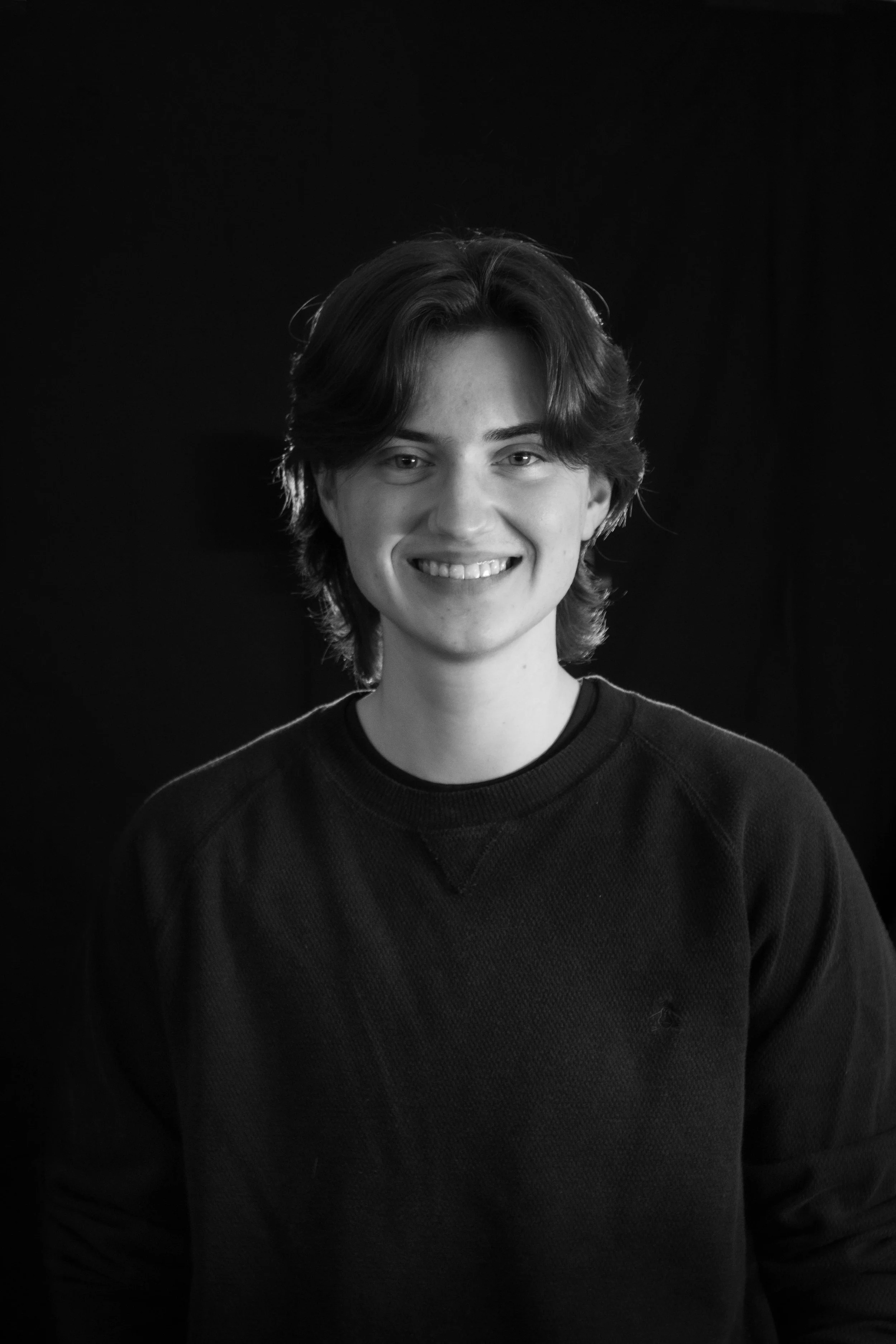
Rory Waugh (he/him) is a junior writing major and writing for film, TV, and emerging media minor. Rory has loved the art of writing since he could put pencil to paper and has only developed that passion through Ithaca College’s writing department. In his free time, he enjoys dancing with IC Unbound dance company, reading whatever he can get his hands on, and doing crossword puzzles with his friends.