
A Stream of Consciousness Reflection on Writing
By Rebecca Brutus, Senior Nonfiction Editor and Staff Content Creator | Edited by Erin Shuster, Senior Poetry Editor and Staff Content Editor
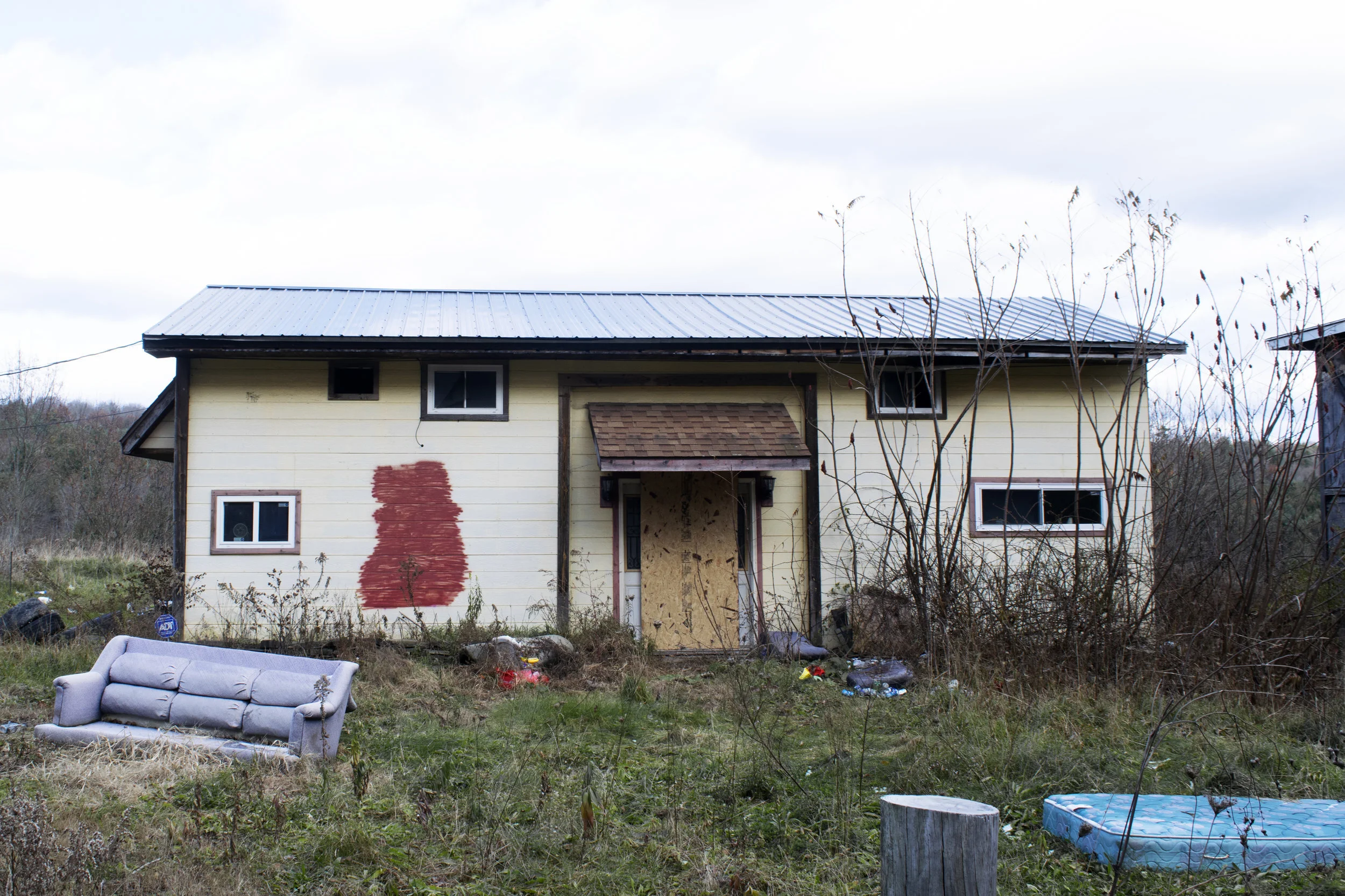
Overgrown by Nicole Brokaw (‘21)
I wonder, often, who I would be without words. I never believed that I was a particularly good writer, nor did I think that I liked the actual process of writing. Writing is hard—sometimes impossible. Sometimes I can’t sit down at an empty page and force myself to sully it with ink and half-formed ideas. There are times when my fingers hover above keys for hours, only to have two sentences make it to the page.
Other times, I feel like I could write forever, words spilling out of me like water, like breath. This, though, is much less common. Most of the time, writing is something I have to wait for. Something I have to push towards. For the longest time, I didn’t think I liked writing.
What I have always liked is creating. I like telling stories, bringing life and thought into previously empty space. There is something inexplicably intoxicating about adding something to the world that wasn’t there before. Like… like singing in an empty room. I used to love to sing, show tunes and spirituals and top 100 hits. I was in choir for a decade, and although I was never the best singer in the room, I loved making something out of… me. Creating, for me, like singing in an empty apartment, filling up the nothingness with a part of myself.
Except in writing, there is a certain uniqueness. There isn’t a set number of notes or keys that can be patterned together. Writing is limitless. No one else can write what I do. No one else is made up of my life, my sight, my thoughts. Writing turns thoughts into words. My dad was a philosophy major for a brief period of time at college before dropping out to support his newborn daughter, my half-sister. Dad loved school; he loved to debate and push people’s buttons. He used to write poetry and want to be a professor; like me, he has always appreciated the power of words. He likes to talk about a question posed to him by a professor on their first day of class.
“Which came first: language, or thought?”
We have discussed this question time and time again, and I’m still not quite sure of the answer. I think it depends on how you define thought. Are feelings thoughts? That is something I could never quite reconcile. If I get burned, I will pull away from the flame. That is instinct. But my ever-present fear of fire, the feeling of unease that keeps me from getting burned again, is that a thought? Probably not. I am probably reading too much into this silly little first-day-of-college activity. I know that language is probably the right answer.
The idea that the human race created words and language without needing to is awesome, in the biblical sense. Humans survived without words; we probably could’ve continued to survive without words. But we created something, instead. We created language and words, music and lyrics, prose and iambic pentameter and rhyme, for no reason other than to express ourselves. Words are the bridge, the fast lane to comprehension. They are the only reason we haven’t destroyed each other in our hubris, and the reason we probably will. New words are created to give names to feelings only some of us ever experience. Old words, words used to demean and denigrate, are called out for what they are and fade from use. Words are what keep me sane, because they allow me to interact with others and with myself. How else would I ever know what I’m thinking, without the vocabulary to put it in perspective? I find comfort in knowing that there is probably nothing I could experience that does not have a word.
When I’m exhausted, after long days without the crutch of coffee or rest, I lose my words. Even the simplest of phrases can sometimes just… disappear from my mind, as if they were never there. It’s been happening more and more as I’ve thrown myself headfirst into writing and academia. I will freeze mid-sentence, mouth open, waiting for something to happen as if I am not in charge of my own mind. Maybe I’m not, in those moments. And each time this happens, I feel a rush of reaction, a wave. Sometimes I find it funny. My friends will shout synonyms at me as I try desperately to describe the word as best I can—“like, uh, something that’s a part of you, uh, begins with a vowel?” Shame is a part of it; as a writer, there really is no excuse for spending nearly half an hour trying to find the word “intrinsic.” But underneath these there is something that I don’t often experience in my day-to-day: an undercurrent of genuine fear, a tightening in my chest that turns my remaining thoughts to static. Because who am I without words? How else can I communicate, operate, function, without words to rely on? Language before thought. Without the words, what am I?
The short answer? I become unknowable; a space in which there should be experience and love and life, but none is present. A black hole of being, making it impossible for anything to escape.
Now the long answer.
Without words, without a concrete and universal vocabulary by which to judge my ideas, I don’t know who I am. They are the only things that bring me peace, that make me a person against the backdrop of seven billion other people. I need words to remember how to feel and to understand how others feel. When my friend tells me that they’re feeling “melancholy,” I can summon that emotion. I remember how it makes my limbs and muscles heavy, how it clogs my mind with cotton. And, hopefully, I can say or do the right things to help ease that sadness. But without my relationship to words? In the absence of something concrete, a connection to tether thoughts to feelings? Nothing would connect. Not the thoughts, not me with others, nothing. I would probably sit in my room and wallow until something else filled that gap.
It occurs to me that I didn’t always have writing. I haven’t always had the vocabulary and the presence of mind to find the words I so desperately needed. In person, I am not the most concise speaker. I’m always worried that someone will misunderstand what I’m trying to say. Whenever there is even a sliver of a doubt that my ideas didn’t come across clearly, I rephrase, reiterate, reword. Because my identity is only as true as other people understand it. Words are the truest way, the only way, that I can get across who and what I am. Before I had writing, before I loved words, I had no connection. No tether. I was completely, inconsolably alone.
There is nothing more frustrating to me than failing to communicate. That’s probably a result of a lot of factors: dysfunctional family life, anxiety, gifted child syndrome… the list goes on. The stakes are heightened in writing. Because in writing, there is a certain expectation of perfection. In writing, you’ve had the time, the forethought. No one sees you stumble over meaning or word choice. No one sees me grasp at nothingness, wishing for the correct word that I know is just on the tip of my tongue. Words are how people relate to each other and connect across all manner of boundaries. So without the right ones, how can we continue to grow and understand each other as people? How can I, as a writer, be confident in my ability to portray the world around me? I write because it is the truest way for me to communicate my experiences and beliefs without being misunderstood.
Some days, I’m not sure if my stories are worth being told. I don’t think that my thoughts, experiences, or ideas are very exciting reads. They’re probably not that original. And while I love writing, I know about a dozen fellow writers in my classes alone whose lives are more interesting and whose minds are sharp enough to make even the most mundane moment full of wonder. It often seems like my clumsily-shoved-together ideas are not as worth reading. It’s a big ask, convincing someone that your words are worth their time and attention. And I have never been good at asking for things.
But I believe that I am the only one who can tell these stories, and so I have a responsibility to do so. There is nothing I write that someone else could do justice. The words that fall out of me are made of myself, everything I’ve ever been, every want I’ve ever had. The works I’m most proud of are made of pieces of myself I have polished and dusted and put on display, but those pieces are more sedimentary rock than fossil. I did not dig them out of myself; they were formed through the pressure and proximity of memory, moment, and comprehension. Everything I write is derived from how I view the world. My work asks readers to suspend their own realities and view my world with me. All I have are words, because nothing else could possibly do me justice. And I just hope against hope that I am choosing the right ones. The ones that reflect me, who I am, and what I’m trying to say.
Does that make sense?