
Travel Diaries: Amsterdam
A Clip Show, or Maybe Just A Way Out
By S. Makai Andrews, Edited by Erin Shuster
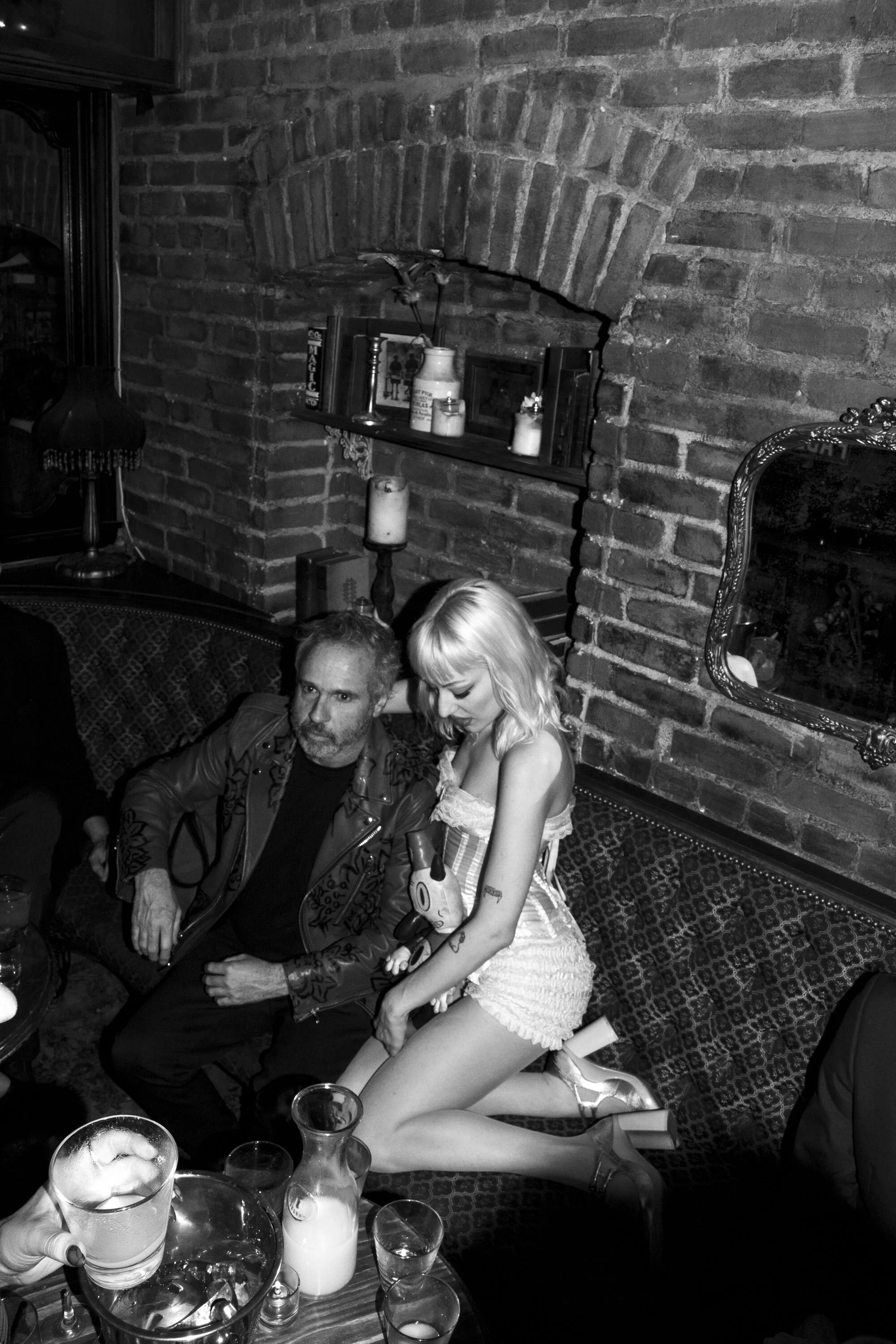
Party Favors - Kneel by Devin Kasparian
You told me I’d be the next great American writer. So here I am, trying to keep that promise. But I’ve forgotten how to write, forgotten anything that exists outside of you. All I can remember are mountains, snow, and sunburns.
When I first see you I’m in a park on my first day in Amsterdam, surrounded by too many Americans attending the same orientation picnic. In a wider scope, we’re surrounded by hundreds of Dutch families spending their day in the park, some with kids running around and others just happily laying out and taking in the last weeks of sun before that infamous rain began.
I think you look full of yourself, cocky, a bit too much bravado. You’re one of the only people wearing sunglasses, sitting with a group of people you know from back home. But you’re leaning out of your group more than the others are, dipping in and out of my group’s conversations instead. Your friend, the picture of a 2010s heartthrob, dips in and out with you until he realizes none of us want to jump his bones, so he retreats back to the people he knows.
You ask to start a group chat, trying to rally a few people together for our first night on the town. I avoid putting my name in, hoping if I pass your phone quickly enough you won’t notice that I dodged it. But you do, and you call me out for it later that night when most of the group has gone home. We’re sitting with the few remaining people around a plastic tablecloth, nursing beers. You learn I like to write, hear from someone that that’s my major, and you pull up a list of poetry and quotes you keep in the Notes app of your phone.
Later, you’ll tell me you did this in hopes of impressing me, flirting with the writer in a medium that was her own. I write about you in my journal that night as an “interesting guy who has poetry in his phone.” When you first kiss me four days later, I picture you in class writing down the lines you like from the books you never read. You’re one of those people who quotes famous lines from things you know you’ll never see.
“When you travel, it takes your soul a few days to catch up.”
I didn’t write that. I don’t even know the person who said it. It’s nothing more than an anecdote an aunt once told my favorite professor, I wasn’t even there to hear her say it. But I liked it so much, I was sure to steal it. But that wasn’t my first theft. I stole you a leather coaster in Prague and a stein from the Paulaner München beer hall in Munich for myself, running past a German officer during the escape.
The first night we kiss almost ended up as a night in the hospital instead. Specifically, a hospital in the middle of nowhere in the countryside of Makkum, a beach town in The Netherlands where the people speak Friesian instead of Dutch. We’re all drunk off free drinks; our trip guides gave us tokens for from the hotel bar. You’re in the height of euphoria: everyone is loud and happy and listening to you tell any and every story that comes to mind. I’m standing with you near a big potted plant. So big, the lips of the terracotta reach my waist. You climb up on top of the plant, saying you know how to do a backflip. You’re stumbling over your words, though I’m sure I am too at this point. Luckily, we’re standing with a few other people so when you do inevitably jump off the top, someone else is there to catch you. I never saw that person much after that night he caught you, since my roommate watched him joyously stab a bee to death with a fork. But still, I think you should thank him again.
Later that night I follow you into your hotel room when you go to grab a coat. Or maybe you were looking for more cash, different shoes, I don’t really know. When we walk in, every inch of the hotel room walls are covered in a thick layer of mosquitos. We saw your roommate smoking out the window earlier when we were on the beach, but thought nothing of it. He wasn’t there anymore, but he’d left the windows open and all the lights on in the room, drawing the mosquitos inside even after he left. We scream, running to the bathroom to grab towels to swat at the walls with. When we run out of energy there are still hundreds of mosquitos on your walls, blurring the white paint with little patches of black. You can see where we were swatting: there are blotches of red and brown dotted everywhere, like someone pricked their finger and proceeded to mark the walls for hours on end. The walls were soaked in blood, but since it wasn’t our blood and we were drunk and the room was sweaty we didn’t think much of it, abandoning the room soon after.
I am not home here, can’t be at home in a place I’ve never been. But you love it here so much it almost feels like I am.
I don’t want to think about you, but there’s no space in my head for anything else. I can’t stop thinking about bottles of wine and chunks of bread in Paris. I want to think about a meadow, about a cold creek that’s half frozen over and falling into itself. I want to think about my grandparents, about my dying grandpa and how little he remembers of who he once was. But I don’t know who he was, don’t know what would make him laugh and what would’ve sent him off the rails. All I know that he hates when ice cream melts, likes his ice cream rock hard to the point where you can’t even get a spoon in it.
It’s easier to think about him dying than it is to remember how happy I was when we were together, living. Sickness is easier to digest than missing you.
“Just say it with confidence, and eventually everyone will believe everything you say.” You used to do this a lot in museums, when we would walk around displays of art from the 1600s and he’d start to spew some alluring shit about the artist’s intentions behind the brushstrokes. You’re a STEM guy; I don’t think you’ve ever studied a brushstroke in your life. But God dammit, if you were there to hear you say it, you would have believed you too.
For the first two months we were there you were one of the few of us with enough courage to try and talk to the locals in Dutch. “Alsjeblieft,” what you had picked up from others as meaning “thank you,” was your most used phrase. It wasn’t until halfway through our semester that someone finally corrected you that “Alsjeblieft” actually meant please, not thank you. So every time you were in a store, a movie theater, a restaurant, a pub, you’d ended up swapping your pleases for your thank you’s. “Please for the check,” or “Please for your service.” I like to wonder what the locals thought, if they laughed at you as they walked away from our table.
When we’re traveling you tell everyone we meet we’re “from Amsterdam,” despite our correcting you otherwise. It feels wrong to claim Holland as our own, but we’ve also been here too long to still consider ourselves tourists. At this point we’re floating, no more than nomads with a connection to our past and a wishy-washy idea of our present.
When your mother visited Europe she brought a suitcase full of America with her. Goldfish, Velveeta cheese, cured meats and all the fixings for FRENCH’s green bean casserole. You’re from Colorado but sound southern, kept that twang your mother carried with her out west. She hosted your friends the way she would a family reunion, wine and food covering every surface of the rented apartment. The only difference was that there was no sweet tea and no Alabama sun. Just a puddle of Dutch rain in the corner where everyone took off their shoes.
“You’re a writer, we have to go here,” you say as we walk inside Shakespeare and Company, a notoriously lauded bookstore in Paris. The shop, a cramped two-story building stuck in the heart of Paris, is famous for housing some of the best writers of the 20th century. There are beds stuck in between bookshelves, the company policy being you can stay the night if you agreed to help out in the bookstore, read a book a day, and write a short biography for the shop’s archives. The idea worked out for them better than anyone could’ve expected, housing writers as big as Allen Ginsberg, Jack Kerouac, James Baldwin, F. Scott Fitzgerald, Ernest Hemingway, and so many more. In fact, you can still stay there today. Just send them an email with the subject line “Tumbleweed,” the name they’ve come to refer to their guests by.
One wall is covered in notes, small pieces of paper ripped from notebooks and pinned haphazardly on top of each other. They’re messages from previous visitors, people who wanted to leave a little piece of them in a space that’s become so sacred to us writers. You ask me for something to write on and I pull out the receipt from breakfast that morning.
“To the outside thinkers, and lovers,” you write. This is the moment when I decide to allow myself to love you.
We sit on one of these beds and argue over who’s the best American author. You say Hemingway, I say Fitzgerald. One of our friends, drunk from the bottles of wine we had earlier that day in the park, comes to every once in a while and reminds us that “Hemingway was a misogynistic asshole.” I convince you to buy a Fitzgerald book and say we’ll continue the argument once you finish it. You start reading it on the bus ride home, but you never do finish it.
A story that goes around often about Van Gogh is that he drank yellow paint in hopes of allowing some of the happiness to finally break his surface and exist inside of him. While this could be an entirely made up story, it’s a nice image to land on in the final throes of a mentally ill life. I like to think that he did, and that it worked. Maybe, even if just for a second, he was able to feel his heart tighten inside his chest and set the littlest puff of air free, allow for a laugh just big enough to fill a newborn’s lungs.
In line at the Van Gogh museum a man, not older than twenty five, holds a royal blue lantern in his left hand. It’s almost three pm on a Friday. A girl in sunglasses walks by with a packet of french fries covered in mayonnaise, the Dutch classic. It’s a surprisingly warm day in Amsterdam, as illustrated by the old man biking by in nothing more than a metallic silver speedo. The Van Gogh Museum has a constant, streaming line around the glass walls of its front entrance. People pour in, stumbling over their words as they’re greeted in Dutch and have to quickly explain that they speak English, Spanish, Japanese, Arabic, or Italian instead. It’s impossible to go somewhere in Amsterdam without hearing at least five different languages, five different ways of asking for directions to the same place.
It’s also impossible to stand in a Van Gogh museum and not take a moment for the man himself. From the Netherlands, everyone there is filled with a hometown pride for this man that could compete with the British’s love for those like Winston Churchill. The odd part is the way the museum paints his life. They jump quickly from his formative years, a brief stint living with his parents, a visit back to his studies, and suddenly he’s cutting off his ear, in a mental asylum, and dead by his own hand all within his last two years.
It’s not easy to see this man in his work, especially in his period from 1886-1887 where his work is filled with bright pops of color, deep yellows and greens that slick the coating of the canvases. These are the colors you see me in, bursts of life that I’ve never felt right to claim. It’s only in a few paintings that this baroque, depressive side of Gogh comes out. This is a more accurate view of me, I think, but you disagree. In his earliest portrait from 1886 you see the man in a dimly lit room, hard at work on a canvas that only he can see. It’s dark, gloomy, altogether out of place in the rest of the room filled with self-portraits of Gogh with cherry red hair and bright colors splotched all around him. There’s few examples of Gogh’s darker side throughout the museum, the other statement piece being “Head of a Skeleton with a Burning Cigarette,” which pretty much looks like exactly how it sounds.
Only in these dark paintings, these shadowed figures of everything Van Gogh was never known to be, do his harsher sides come out. It’s here where one can believe that he cut his own ear off, here where the stint in the asylum makes sense. The museum has blurbs scattered around the walls, explaining how even when he was in the asylum he was diligent to continue working on his craft. Gogh himself describes the first time he was able to “see [his] canvases after [his] illness,” further inclining him to focus on his brighter works.
There was a chunk of the day once a week in my preschool that was allotted for “sharing time.” Everyone brought in one thing from home to share with the group. One thing that they loved, that they thought was special or exciting to see. I remember once bringing in a hand-bound notebook that my Grandma helped me make, fingering the blue and red ribbons that sewed the book together while I talked about just how special that book was to me. Admittedly, I have no idea where that book is now.
At the end of each turn, after someone had showed off their favorite toy or the new book they got that weekend, a little time was leftover for questions.
“What’s his name?”
“What is the book about?”
“How long have you had it?”
“Where do you keep it when you’re sleeping?”
That last one was the most popular question, where you keep it when you’re sleeping. There was a rehearsed answer we all somehow knew to say, a secret preschool code that dictated your most special things could only be in one place when you were sleeping: next to your bed, still in sight even when your eyes were closed.
I’ve been keeping the Colorado pin you gave me next to my bed, holding to the tradition that what is most special must remain close.
But don’t get me wrong, this is not a love letter. I can’t write you a love letter knowing that I may never see you again. That wouldn’t be fair to either of us.
Two days after the Notre Dame spire falls I get a text from my mom that there’s an active shooter warning by your college. I haven’t seen you for four months. All of this, the trips and Amsterdam and the smaller memories are beginning to unstick from my memory, folding in at the seams and hiding inside themselves.
I start to message you even though I know you won’t respond this early. It’s only nine in the morning here, and you’re two hours behind me. But I keep texting, keep looking up new alerts from the Denver area about which schools are closing and reading pleas from the father of the suspect for her to stop and come home.
On the way to Paris the bus driver kicked us off outside of the city, near the airport. It wasn’t long past four in the morning and we’d collectively slept for maybe two hours. We had to take the subway into the city, loading on with the French, early-morning commuters who can’t afford the cost of rent in the city center. I remember we got down to the platform and you realized you had to pee so you went back out the exit and had to buy a second ticket in order to make our train.
The Notre Dame was the first thing we saw when the subway peaked up from underground, cemented in my mind as my first image of Paris. The sky was shades of blue and peach, the sun having just risen overhead. Paris is your favorite city, and she treats you right. When we go out to dinner I do something to irritate the waitress so she refuses to bring me my food. I’m left with melted ice and watered down vodka, trying to flag down a different waiter, while you feast on two plates of escargot and a slab of steak as big as my head.
As it turns out, the active shooter doesn’t end up killing anyone except herself. Found in a motel room outside of Denver, she used the same shotgun she had bought the day before that set off the initial red flags for the active shooter alerts. You responded to me after a couple hours, as relaxed and cheerful as ever, saying yes your school was on lockdown but no you weren’t afraid. That you have to stop being afraid when bad days make a habit of turning into nationwide tragedies.
On that first weekend, a group of us went out to dinner along one of the smaller canals. A friend from Brazil taught me a new word that doesn’t exist in English. The word was saudade and it means “a deep emotional state of nostalgic or profound longing for an absent something or someone that one loves.”
I’ve been leaving spaces for you. Expecting you to show up on the couch next to me, sitting in restaurants thinking somehow the empty seat next to me will turn into you. I’ve grown so accustomed to having you around I’ve forgotten what it’s like to be alone. I make eggs the way you like them, still buy foods at the market you always liked me to keep in the house. Popcorn, butter, M&Ms, dark whiskeys. I visited a cousin a few days after leaving you and thought I smelled you in the room, only to find out you both wear the same cologne. I wanted to stuff cotton balls up my nose, fill them with plaster until it sopped out of my nose and sealed my eyeballs shut too.
It’s hard to talk about Amsterdam and not about the people I’ve met. Hard not to talk about the boy I’ve spent so much time with, the boy who sounds like a folk song and smells like forest pines and slush. So when I go home, when whatever this is inevitably runs out of time, I’ll remember you and everyone else with the reflection of the Dutch sunrise on their eyelids. Wrap up the smell you leave in my room after a movie night. When you’re gone I’ll remember you in blips, remember you when I see a biker alone on the street at night or the next time I hear someone order a whiskey-coke at a bar. This is how I want to remember Amsterdam. French fry hands greasing bike handlebars, bridges over the canals that look too perfect to be real, a long list of beers to try before we run out of time.
Note from the Author:
This project began as an idea for Katie Marks’ Image-Text course. I had been studying abroad in Amsterdam the semester prior and upon returning home received a Christmas gift my mom had made for me of a scrapbook of all the images I’d sent her during my travels. She then asked me to fill in the “journaling” sections of the scrapbook, arguing it had to have my voice to truly be complete. This proved to be more difficult than expected. I was heartbroken about leaving Amsterdam and could not find words strong enough to express what it felt like to be ripped from somewhere that finally felt like home. And, of course, it didn’t help that the end of my abroad experience also coincided with the end of a relationship with a boy I’d met while abroad. My initial vision for the project was to push the boundaries of what a scrapbook could be, focusing on more internal moments and less on simple description of each image. Writing this was as cathartic as it was painful. I hope people can see some of their own experiences of moving and change reflected in the text.